

On February 28, the 2-gigawatt Lingwu Phase II photovoltaic project of CHN Energy Ningxia Branch completed trial operation and was officially handed over for commercial operation, marking the full completion and commissioning of the 4-gigawatt Lingwu new energy base built on a coal mining subsidence area, the largest single-site project of its kind in the country.
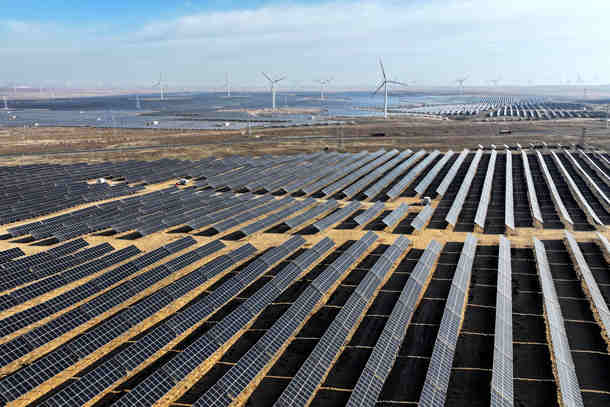
With this milestone, the Ningxia coal mining subsidence area new energy project, with a total installed capacity of 6 gigawatts, has achieved full-capacity grid connection. The project consists of two integrated photovoltaic bases: a 2-gigawatt facility in Ningdong and a 4-gigawatt facility in Lingwu, covering a total area of approximately 180,000 mu (120 million square meters). Supporting infrastructure includes one 750-kilovolt booster substation, six 330-kilovolt booster substations and 200 kilometers of transmission lines.
Electricity generated by the project will be transmitted through the Ningxia–Zhejiang ±800 kilovolt Lingzhou–Shaoxing ultra-high-voltage direct current transmission line. It is expected to deliver approximately 10.8 billion kilowatt-hours of clean electricity annually to East China, equivalent to meeting the yearly power demand of 7.2 million households and saving about 3.24 million tons of standard coal.
The project adopts a bundled transmission model combining photovoltaic and thermal power generation, relying on the regulating capacity of supporting thermal power units along the Lingzhou–Shaoxing DC line to smooth fluctuations in photovoltaic output. New energy is transmitted by expanding the 750-kilovolt booster substations of nearby thermal power plants, enabling shared use of transmission channels. A 600-megawatt/1,200-megawatt-hour energy storage system has been planned, of which 400 megawatts/800 megawatt-hours have been completed. Grid-forming energy storage technology has been applied to enhance the station’s active grid support capability.
In terms of construction, the project utilizes a self-developed three-dimensional mountainous photovoltaic design module to coordinate terrain planning and optimize module layout. To address the complex geological conditions of the subsidence area, multiple support structures have been adopted, including fixed mounts, flexible mounts and flat single-axis trackers. A smart construction management platform has been established to enable full-process digital management and control of the project.
In technological integration, the project has achieved several firsts. A large-scale regional photovoltaic intelligent control integration system enables the fusion of on-site and remote centralized control. An intelligent geological subsidence monitoring and early warning system allows precise monitoring of settlement at the gigawatt scale. A mobile smart engineering management system addresses the challenges of overseeing widely dispersed sites, while an intelligent health analysis and diagnostic system for photovoltaic modules improves fault identification accuracy. Intelligent drone inspections can identify 12 types of module defects, and automated cleaning robots perform unmanned cleaning operations.
Beyond supplying substantial clean energy to Ningxia and Zhejiang, the project also contributes to improving the ecological environment of the coal mining subsidence area. Developed under a photovoltaic + ecology model, the project makes site-specific and efficient use of surrounding idle land resources. It has developed integrated photovoltaic, ecological and livestock production technologies to establish a circular industrial chain combining power generation above the panels, crop cultivation beneath them, livestock breeding between arrays, and sand control and soil improvement. This approach has created a demonstration zone featuring the integrated development of photovoltaic power, ecology and animal husbandry with distinct regional characteristics, improving the ecological environment of the mining area, stimulating local economic growth, creating employment opportunities, and achieving a win-win outcome for both ecology and the economy.

